Showing posts with label Song and Dance. Show all posts

Tuesday, April 19, 2011

“People Like a Little Glamour”

   
Lifelong musical theatre geek Claire Willett interviews Christopher Stowell about her all-time favorite work in the OBT rep: Stowell’s sparkling, sexy, witty Cole Porter ballet Eyes On You.


Christopher Stowell. Photo by Joni Kabana.

What inspired Eyes On You?  How did you come up with the idea?
Well, the practical reason was doing something to recording [because of] not having finances for live music for that program.  We opened in the Newmark that year because of The Lion King, we got kicked out of the Keller . . . so there was no orchestra for that program . . . I needed to make a new ballet and I couldn’t use live music.  And my thing with recorded music is, if it’s a great, famous, vintage recording, and it’s something we can’t recreate now, then it’s fine.  Like, we had done Paul Taylor’s Company B, which is all Andrews Sisters recordings, so of course you do the recordings, you know – those are the people!  You know what I mean?  So I was looking for a composer that was fun, and that there were interesting recordings of their work, and I liked the idea of vocals in the program.  And then it took a turn when Pamela South said, “Oh my God, I love those songs, I would love to sing them,” and I said, “Well, we don’t have any money for you,” and she said, “Well, let’s not worry about that.”  But I had already gotten attached to some recordings, so I said, “How about we alternate between vintage recordings and live?”  Which is actually kind of cool, I think.

So were you, like, a lifelong Cole Porter fan?  I know you’re kind of an old-movies buff . . .
Not particularly Cole Porter – I discovered actually a lot of songs that I knew, that I didn’t –

That you didn’t know were Cole Porter?
Exactly, and I think we all do that, you know?  Like, “Oh, I love that song, who wrote that?  Cole Porter.”  You could say that about, like, eight hundred times.  He wrote ‘em all.  (Laughs) I don’t remember, but it’s possible that I was not even attached to necessarily Cole Porter strictly in the beginning, but then I saw the wealth of great songs.  And what’s really good is that there are a lot of recordings that are not all the same – they’re not all from the same period, they’re not all necessarily sung.  Like, “Begin the Beguine” in the ballet is a non-vocal version.  “Night and Day” is usually a slow song, but the recording we have of it is fast.  So you can have all Cole Porter but you can also have it from different eras and different approaches. 

Who picked the music?
I picked all the recordings myself, and then picked songs where I couldn’t find  . . . recordings that were danceable, or that I felt like were going to fit in, and those were the things Pamela ended up singing because we could adjust the tempo, take out the bridge, or whatever.

Christopher Stowell's Eyes On You. Photo by Blaine Truitt Covert.


One of the things that really struck me the first time I saw it was how cinematic it feels, with the “The End” marquee and the costumes – was that a deliberate choice or did it evolve as you were working?
I honestly don’t remember exactly the route to that particular idea.  What I do remember is just liking the idea of some stereotypical characters, or notions, or situations that happen in those Hollywood movie musicals of the 30’s and 40’s.  Like, there’s frequently a bellhop, and there’s often girls that are secretaries on their lunch break.  And Latin locales, themes and rhythms were really popular then, so, you know, non-Latin people doing rhumbas and sambas and feeling really sexy is also in all of those movies, frequently.  So there’s that in there.  The actual marquee – I think that the very first image I had that included the seats was being ironic and starting at the end of something.  And what would people be going to in the 30’s and 40’s?  They’d be going to the movies.

You mentioned the rhumbas and the sambas, and there are so many different other kinds of non-ballet dance that are sort of incorporated throughout –
Yeah, I guess because it’s natural to those rhythms to want to move in a social dance way.  I have actually no social dance training, so everything that’s in there I made up based on some feeling of, like, “Isn’t this kind of like one of those things?”  (Laughs)  There was one social dance that I had somebody teach me and I can’t remember who it was – it’s in “Begin the Beguine,” the main step in that –

That one’s legit?
Yeah, that one’s legit.  The rest I made up.

It’s like the Christopher Stowell version of a foxtrot.
Exactly.  If you wiggle your hips, it’s a mambo.  (Laughs)  


Alison Roper and Ronnie Underwood in Christopher Stowell's Eyes On You. Photo by Blaine Truitt Covert

 
So what’s your choreographic process for a work like this?  Anne talked about it a little in her interview from her perspective as a dancer; what’s it like from your end?
Well, this one in particular, the structure of it was comforting, or non-scary, in that it’s episodic – it’s a bunch of numbers.  And each number – there should be an arc, but it doesn’t have to be an arc of logic, it needs to be an arc of aesthetic or style, or at least highs and lows that feel like you’re on a little bit of a journey or whatever, but they’re each separate numbers.  So I thought, “Who are the principal characters in this?” and then assigned the characters and the dancers I had in mind to particular songs.  And then that process makes me feel comfortable; it’s like not having to think about, I don’t know, like reading all of War and Peace.  It’s just a chapter, so everybody calm down.  It’s just a chapter at a time.  

Baby steps.
Exactly!  Baby steps, yeah.  And then I decided, “Okay, I’m gonna pick a song, and it’s gonna be a song that I associate with Anne, and that’s just gonna be how we get started.”  So I’d get in a room with her, with a song that I feel like is about her or for her, and just see what comes up.

Is that different from how you’d choreograph something like Rite of Spring with the bigger arc to it? 
No, actually.  Rite of Spring scared the shit out of me – unlike, you know, ten cute Cole Porter tunes.  (Laughs)  And I started the process exactly the same way, to calm myself down.

Break it into little chunks.
Break it into chunks, and get one person in the room – Anne, let’s say – and let’s make something up.  Because as soon as I have something to work with, I feel better.  When I feel like I have to come up with thirty-five minutes of steps, I’m like, “Oh my God . . .”


Anne Mueller in Christopher Stowell's Eyes On You. Photo by Blaine Truitt Covert.


When it’s like, staring you in the face and you’re like, “Holy crap.”
Yes!  Exactly.  So it’s like, “Okay, let’s make two steps, and then we’ll make four steps . . .”

One of the things I like about Eyes on You is that it’s so funny – I feel like that’s something that comes through in a lot of the works in our rep.  Is that something that you like in your work?
Yeah, definitely.  I do like to do that.  But I like to mostly make situations that can be funny, and not say, “Here, do this gag,” and “Here, do that gag,” overtly.  There are some gags in this – there are, but they need to be done subtly.  I didn’t want it packed with one spit-take after another.  Like, that’s too much.

Slapstick.
Slapstick, yeah.  But it also makes sense with both the music and the aesthetic that inspired the thing, because those movies often were comedies, so I like the funny situation more than the fall-down-on-your-face stuff.

Did you watch a lot of the old 40’s movies when you were a kid?  Did you grow up with that aesthetic?
Fred Astaire movies, for sure.  Fred and Ginger stuff.  My father is a huge fan of all of those movies – Gene Kelly, the whole genre.  Yeah.  So I did grow up seeing those.  But then I actually got my hands on – I can’t remember what they were now – some movies that I did not know that were Cole Porter scores.  And that was actually helpful because they were kind of obscure, so, I mean, they were probably fun at the time but they’re not classics, you know what I mean?  But it gave me some insight into different situations than the ones we remember all the time.  They were so specific, you know – they did a lot of, like, they’re in a war, or they’re stuck in Panama . . .

The catalog is just huge.
Yeah.

The number of things he wrote –
They must have churned them out, those movies.  Like, make it in two weeks, boom, let’s go.

Did you do musical theatre as a kid?
Nope.  I would have been happy to, though.  I acted a little bit when I was a kid, before I started ballet, in school.  I did do Annie, Get Your Gun.  Yes.  I was Little Jake in Annie, Get Your Gun.  If I’d had any kind of voice I would have preferred doing that, frankly.  Way more fun.

More fun than ballet?
Yeah!  Ballet’s hard!  It’s a lot of work!  (Laughs)

And there’s no jazz hands in ballet.
No jazz hands!  I know! 
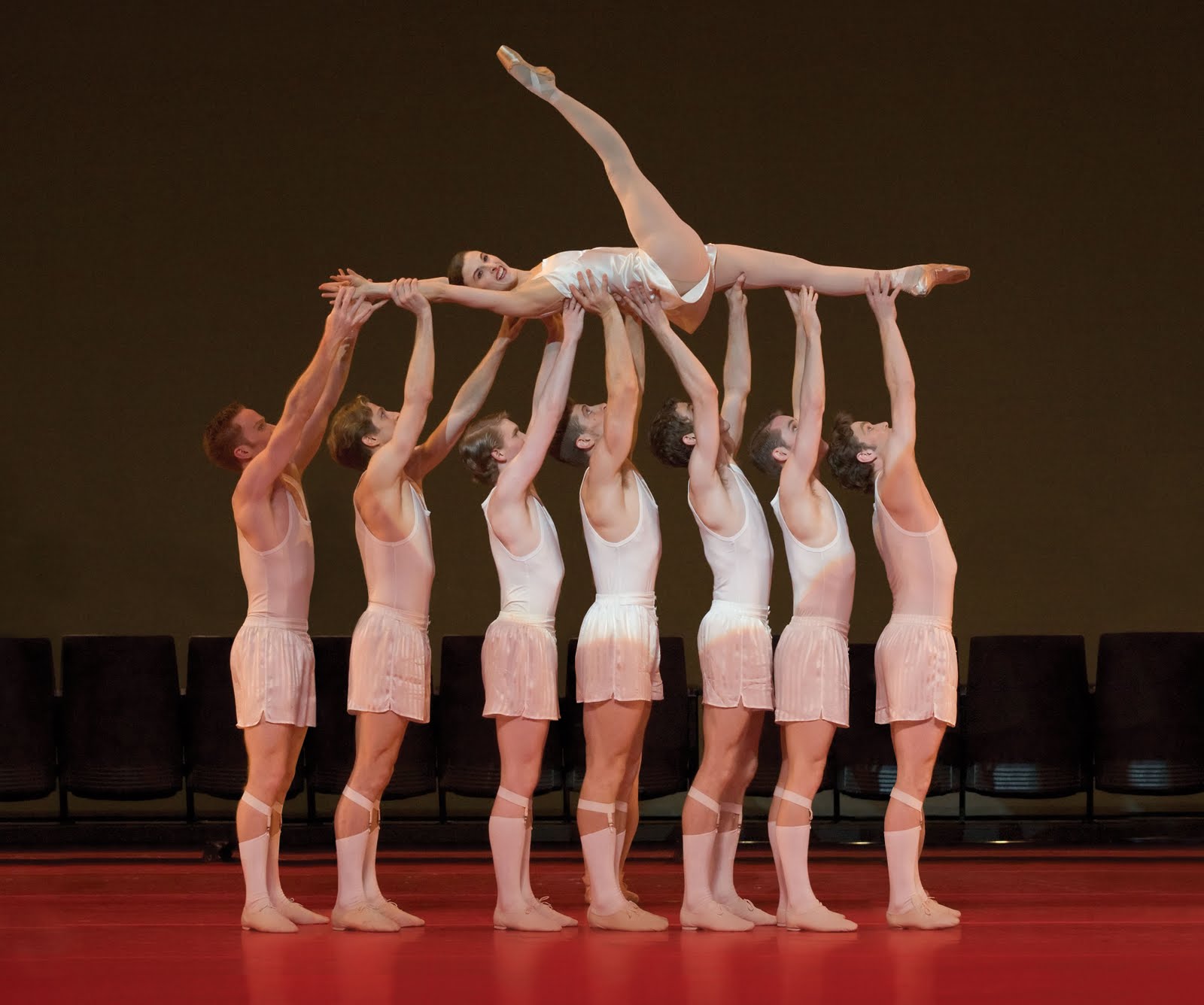

Anne Mueller and company in Christopher Stowell's Eyes On You. Photo by Blaine Truitt Covert.

Eyes On You is such an audience favorite.  Why do you think people respond to it so much?
I hate to use the word “accessible,” but I think the thing that scares people sometimes about dance is “I don’t get it,” and there’s no question of not getting it, really.  Well, actually – once, I forget if it was a review or if it was someone talking to me, but they said, “I don’t get why they’re in their underwear,” and I’m like, “Uh, it’s funny.  That’s it.  That’s the end of the story.”  “Well, if they were in the movies they wouldn’t be in their underwear!” And I’m like, “Um, you’re thinking way too hard.” (Laughs)  Like, it’s madcap.  Whatever.  What was the question?  Oh, accessibility.  Right.  So, comfort level – I think it makes people relaxed, like, “I get this genre.”  I think a lot of people like a little glamour too, and it has beautiful costumes that move a lot.  And all of that also makes the dancers relax, and I think audiences get to see maybe more personality than they might in other [ballets], which is more appropriate in this, too.  And it’s very infectious music, too.  You feel yourself snapping your fingers a little bit, like, “I know the words to this song.”  It’s just fun.

What’s your favorite Cole Porter song?  Do you have a personal favorite?
My favorite recording in the show is the first one, “De-Lovely,” because it’s really, really clever – the lyrics are really clever.  You know what’s really good – it’s not in the show – is, how does it go?  (singing unintelligibly under his breath) Oh, it’s “Let’s Do It, Let’s Fall In Love.” Brilliant lyrics, so funny.  I almost used a recording of Alanis Morissette singing that [from the film De-Lovely], but it kind of fluctuates tempo a lot – so you’re like dancing dancing dancing, “Wait, why is she slowing down?” [EDITOR’S NOTE: Rather than transcribe for you the next 5 minutes where we geeked out about the De-Lovely soundtrack, I’ll just give you the link and tell you that Christopher’s favorite track is “True Love” sung by Ashley Judd, and mine is “Night and Day” sung by Kevin Kline with John Barrowman of Doctor Who and Torchwood fame.  Now back to our regularly-scheduled programming.]

So how does the process change, now that you’re doing it again with different dancers?
Honestly, with a ballet like this, it is a little – not “challenging,” but there’s another dimension to it.  Because you want, if not the same, a similar, equally effective effect, and people are different people with different bodies and different personalities.  So I probably adjust things in this more than I would in something else, because the point is the ultimate effect and not the individual steps, necessarily, or where to put the emphasis of either a gag, or a romantic look, or whatever like that. But I do get attached in something like this more than in other things, like, “You’re not doing that thing that so-and-so did that was so funny!”  But then I have to step back and go, “They can’t be that person.” And I’ve found that asking them to do something that was basically an inspired moment by one dancer, asking another dancer to do it is usually not effective.  It wouldn’t feel natural to them.

So what made you decide to bring it back for this season, and how does it fit in with the other pieces in Song & Dance?
Well, we brought it back because, you know, marketing directors are always happy.  Like, “Give me something that’s gonna sell a lot of tickets!”  (Laughs)  In this particular program – so Square Dance wasn’t on the program yet when I planned it because we added it later.  [With Left Unsaid and Speak], well, I don’t know if “heavy” is the right word, but there’s some darkness and some earthbound-ness and some seriousness about those works that needed some complementing with something light.

How did you come up with the name Eyes On You?  It’s not in any of the songs in the piece.
The naming of the piece was actually fun.  I was choreographing it during OBT Exposed!, when we had the tent in the park in the fall, and I think we showed some Cole Porter movies in the evening and had some popcorn, to sort of get people who were interested in the ballet focused on Cole Porter and the process of creating this new work.  And then I think I had to give a lecture one night, and I hadn’t come up with a name for the piece, and I said, “Well, I’ll throw it out to the audience.”  There were maybe fifty people there, and everyone wrote down their thought for a name for the piece and we collected them, and – it was actually longer, it was “Eyes on blah blah blah blah blah something,” but I read all of them, all those little slips of paper and then saw that one.  And I reduced it, edited it a little bit, and liked it, and got in touch with that person, and they got credit and free tickets to the ballet.

That’s awesome.
Yeah.  I like the title.  People have said, you know, is it “Eyes On You” or I-apostrophe-S, like “I’s on you?”  (Laughs)

It works on so many levels.
Yeah.


-----------

Song & Dance, featuring Eyes On You is at the Newmark Theatre April 21 - May 1.

more posts about Song & Dance | Buy Tickets to Song & Dance

Friday, April 15, 2011

Your Daily Dance Break: Yo Yo Ma and Lil Buck

It seems we are not the only ones creating a little classical/hip hop fusion. Check out this extraordinary video of famed cellist Yo Yo Ma collaborating with hip hop dance artist Lil Buck on a brief improvised performance piece.

We present this in honor of our sister organization Portland Center Stage's opening night performance of Opus. Break legs, guys! Or, as we say in the dance world, "Merd."

Thursday, April 14, 2011

Gargouillade and Entrechat: the Filigree Footwork of Square Dance


by Linda Besant

“More steps per minute than any other show in town,” said dance writer Nancy Reynolds of Square Dance. For fifty years, audiences have been wowed by this non-stop ballet:

“Tempos that could only be called lickety-split.” (Manchester, 1958)
 “Filigree footwork that requires the most astonishing technical dexterity.” (Kaplan, 1988)
“The speed of the footwork…could be compared to breaking the four-minute mile.” (Vranish, 2007) 

Pacific Northwest Ballet principal dancers Carrie Imler and Lucien Postlewaite with company dancers in Square Dance, choreographed by George Balanchine © The George Balanchine Trust. Photo © Angela Sterling
Patricia Wilde, on whom the principal role in Square Dance was created in 1957, described Balanchine's emphasis on the foot in this kind of choreography. “From the moment it left the floor, the foot had to draw the eye to it -- we really worked on that." Under Balanchine's direction, less time was spent in plié or in preparing for a movement. "Don't sit there and have a cup of coffee," he would say, pushing for accents that were out and up. Square Dance “has a terrific bounce and a very unique drive. It was a joyous experience. Mr. B wanted it to be fun.”
Merrill Ashley, who took on Square Dance in 1977, remains among the most acclaimed ballerinas to accomplish the principal role. "The ballet was filled with fast footwork, jumps, and beats, all part of the standard classical ballet vocabulary, but the steps had to be done in a much freer and more spontaneous way than in most 'classical' ballets. A joyful I-love-to-dance approach was needed . . . Many of the steps seemed to have their own momentum, which swept me along, and I felt in perfect harmony with the music and choreography."     

OBT’s Ballet Master Lisa Kipp taught Square Dance to the company. She performed it with Ballet Chicago in the 1990s. “It’s one of my best memories, and the music is beautiful,” Lisa says, “but it was the most exhausted I ever got, ever, You have to reach down into the depths and pull something out if you’re going to get to the end of the ballet. You hit the wall and go past it. There’s a weird euphoria to that.”

Here are a couple of examples of the allegro steps and jumps in Square Dance that dancers find most challenging:

Gargouillade: (literally means gurgling or rumbling) Both legs execute a rond de jambe in l’air (circle of the legs in the air) almost simultaneously, while the body is in the air. “Like a kitten with tape stuck to its paws,” says OBT dancer Andrea Cooper.
This video excerpt of Pacific Northwest Ballet's Square Dance rehearsal shows Carrie Imler tossing off her gargouillades with ease. She does the first gargouillade at the very beginning of the video, and the corps repeat her movement in the next moment.


Long strings of échappés interwoven with entrechats six        
Échappé: An escaping or slipping movement where the feet go from a closed to an open position, both sauté (jumping the feet apart), and sur les pointes (on the toes).
Entrechat six: Interweaving or braiding. A step of beating in which the dancer jumps into the air and rapidly crosses the legs before and behind each other.

Christopher Stowell says, “It’s not so much that these steps are hard but that there are so many of them.” Damara Bennett, Director of the School of OBT, adds, “It’s relentless, and exhilarating.”

To see demonstrations of échappé and entrachat so that you can recognize them in the finale of Square Dance, visit American Ballet Theatre's Online dance dictionary.


more posts about Song & Dance | Buy Tickets to Song & Dance

Thursday, April 7, 2011

Yoga and Ballet: Finding the flow in "Left Unsaid"

By OBT Historian Linda Besant


Are Locusts and Downward Facing Dogs a regular part of your life? If so, then you won’t want to miss seeing Left Unsaid in OBT’s “Song and Dance” program that opens April 21st. Choreographer Nicolo Fonte is a devoted practitioner of Iyengar yoga, and his ballet is rich with artistically extended poses.

We asked Julie Gudmestad, one of Portland’s premier yoga instructors, to take a look at Left Unsaid and weigh in on this seamless melding of Eastern and Western physicality. Julie has movement credentials that just won’t quit—she graduated as a physical therapist in 1977, and she’s been certified as an Iyengar instructor since 1988; but we didn’t know until we asked for her help that she also studied classical ballet as a girl, and was a serious student of modern dance at Reed College.

Julie knew of worldwide movements of rhythmic yoga and yoga choreography, but said right away that Left Unsaid is different. Those ways of moving are built exclusively from poses, or asanas. “In formal practice,” Julie said, “it’s pretty prescribed how you go into and out of each pose, especially in Iyengar yoga. What’s so refreshing about Left Unsaid are the creative and organic ways that Nicolo Fonte coils into and on through each pose. In yoga practice, we form vinyasas, or flowing combinations of asanas. One definition of the Sanskrit word vinyasa is wind, and you can see the wind in this piece. People who practice these poses will be delighted at the way this choreography flows.”

Julie also complimented OBT’s dancers. “It is a real treat," she said, “to see people in such fabulous shape, who have both the flexibility and the strength to do the extreme forms of these poses." In fact, many of OBT's dancers regularly practice yoga. 

We picked a part of Left Unsaid where the yoga is particularly clear, and Julie pointed out places where the choreography lingers on poses long enough to see them clearly, though they are often varied or ornamented slightly. You will see:

Warrior I Virabhadrasana I
Bridge Setu Bandha Sarvangasana
Boat Navasana
Locust Salabasana
Staff Pose (Plank) Dandasana
Standing Big Toe Pose Uhita Hasta Padangustasana

Can you spot these asanas as they flow by?


Julie Gudmestad practices physical therapy and teaches yoga with her team of nine instructors at Gudmestad Yoga Studio. You can also see her work in the Yoga Journal online, where she wrote the "Anatomy of a Yogi" column for seven years.


Love yoga? Show us your own best yoga move by posting a pic on our Facebook Wall and you'll be entered to win tickets to Song & Dance. We'll pick a winner Friday April 15th. GO.


Tickets to Song & Dance


more posts about Song & Dance
| Buy Tickets to Song & Dance

Wednesday, April 6, 2011

Nicolo Fonte Discusses Left Unsaid with Dance Magazine


(Anne Mueller, Artur Sultanov, Brian Simcoe and Steven Houser in Nicolo Fonte's
Left Unsaid. Photo by Blaine Truitt Covert)

Wendy Perrin from Dance Magazine recently sat down with choreographer Nicolo Fonte to discuss his approach to choreography and his current most popular work, Left Unsaid, which will be presented as part of our spring program, Song & Dance.

Check out the interview here.

You can watch a full sneak peek video of Left Unsaid here:


more posts about Song & Dance
| Buy Tickets to Song & Dance

Monday, April 4, 2011

Daily Dance Break: A Different Kind of Street Dance Battle

Here's a little taste of the kind of street dance battles that are referenced in Trey McIntyre's Speak, which is part of our Song & Dance program opening April 20th.


more posts about Song & Dance
| Buy Tickets to Song & Dance

Friday, April 1, 2011

"It's Really a Street Brawl"


 Former OBT dancer Matthew Boyes shares his memories of Speak, Trey McIntyre’s ballet set to a spoken-word piece by Tracie Morris and the hip-hop music of The Bloodhound Gang.

Vanessa Thiessen and Matthew Boyes in the world premiere of Trey McIntyre's Speak.
Oregon Ballet Theatre, 1998. Photo by David Straub.
By Claire Willett

How was the piece conceived?
Speak was created on Vanessa Thiessen and myself when OBT was still [performing] in the former Masonic Temple, now the new wing of the Portland Art Museum.  Trey had already choreographed Like a Samba [on OBT dancers] and I believe this was his second piece for the company.  It is a true reflection of pop culture at that time.  Both Trey and James Canfield were always inspired and intrigued by contemporary life.  Rap music and hip-hop had already been around for a number of years, but spoken word was just coming out.  Spoken word [had] a more urban/intellectual vibe; people would go to coffee houses and act like modern-day beat poets of sorts.

What was Trey’s vision for the piece?
He really made the duet . . . a conversation between two people.  He would never talk about what to [think] while dancing this.  Every movement [he] choreographed expressed exactly what he wanted, without him [needing to waste] words on explanation.  [The piece is so] different from most classical dance in that there is no love story told between the man and woman.

What was it like to dance Speak?
When we would rehearse he pushed us to our physical extremes, traversing the stage from end to end. For me, if the choreography called for a gesture or kick, it had to start from a thought and explode as a movement.  The duet is really a "street brawl" between two friends.  [It’s] a battle of the sexes with the girl kicking the guy’s butt – literally and figuratively – in the end . . . The female solo was just raw movement, and looked nothing like ballet.  Of course it takes a trained dancer to make this type of dance really look tight and fierce . . . After dancing Speak I would want to just lay on the floor and catch my breath, but as soon as I rolled offstage I knew I would have to turn around and run out for the bow.


SPEAK - excerpt from Trey McIntyre Project on Vimeo.

How did audiences receive it?
The audience would always go insane with applause!  People really liked it.  Usually it would be sandwiched in the middle of the evening's program [and] the other ballets would be more “balletic,” so the contrast would really surprise and wake up the audience.

On Anne Mueller
I would like to congratulate Anne Mueller on her many years with both James and Christopher at the helm of the company.  Her personal integrity and work ethic, not to mention her beauty, have stood as an excellent example for [several] generations of dancers. Thank you, Anne, for your friendship and unstoppable drive. 


more posts about Song & Dance
| Buy Tickets to Song & Dance

Your Daily Dance Break: A Very Special Guest Star

We are THRILLED to announce that Christopher Walken will be a very special guest star in "Eyes On You" during the run of Song and Dance! Check out the video for a sampling of his dance moves.


more posts about Song & Dance
| Buy Tickets to Song & Dance

Wednesday, March 30, 2011

Your Daily Dance Break: A Contotionist Does a Yoga Inspired Dance

A quick survey of other dances inspired by yoga (like Nicolo Fonte's Left Unsaid in our upcoming Song & Dance program) reveals the following:


We think she must be made out of rubber. Don't you?


more posts about Song & Dance
| Buy Tickets to Song & Dance

Friday, March 25, 2011

Daily Dance Break: Fred and Ginger dance to Cole Porter

Our dancers are in studio this week rehearsing Christopher's inspired Cole Porter romp "Eyes on You." In honor of their hard work, here's a look back at another pair of dancers taking on Cole Porter- in this case, Fred Astaire and Ginger Rogers!

Thursday, March 24, 2011

Balanchine's First Square Dance Caller

Gents go ‘round, come right back,
Make your feet go wickety-wack . . .


Crackerjack square dance caller Elisha Keeler was profiled in The New York Times and The New Yorker in 1957. Next thing you know, George Balanchine was making a new dance to the music of Baroque composers, prancing his City Ballet dancers through all kinds of stage geometry. He named it “Square Dance,” and invited Keeler to “call” it.

Keeler had only been to the ballet once in his life. He watched rehearsals, and with the help of his wife and kids, wrote the calls. “We asked him to say anything he wanted, as long as he didn’t use ballet terms,” said Balanchine.

Keeler was a colorful character, a horticulturist in his day job, famous for his way with African violets. He played piano, banjo, cello, trombone and harmonica, and his daddy was a caller before him. His family band—wife Lois on accordion, daughter Mollie on fiddle and son Kenny on banjo and trombone—often accompanied Keeler’s dances. They were known as the Happy Humdingers. Keeler made singing radio commercials too.

Keeler “sang” “Square Dance” every time it was performed at New York City Ballet from its premiere in 1957 through 1964. He called at over 2,600 festivals and conventions over his long life, but his family said “being part of the ballet was probably the high point of his calling career.” Wrote Time Magazine, “. . . when Keeler had twanged out his last call ("That is all; the dance is ended/ The music is finished; the caller's winded''), audiences cheered the blend of do-si-do and pas de deux.” Keeler passed away in 2005, at the age of 98.

Oregonians have a rare opportunity to see “Square Dance” its original form with OBT’s performances. Balanchine revised the ballet in 1976, and dropped the caller from the scenario.


(Photo: Portland violinist, composer and actor Tylor Neist will reprise Elisha Keeler’s role in the OBT performance of "Square Dance," part of the Song & Dance program playing in the Newmark in April)

Photo Above: Elisha Crofut Keeler, circa 1955


more posts about Song & Dance
| Buy Tickets to Song & Dance

Friday, March 11, 2011

Daily Dance Break: Nicolo Fonte Explains the Hows and Whys of Choreography

Ever wonder what inspires a choreographer to create a particular piece in a particular way?

Here's a quick video from choreographer Nicolo Fonte (who's Left Unsaid will be performed as part of our Song & Dance program in April and who will be world premiering Petrouchka as part of our season opening performance next year) explaining the hows and whys of creating a specific piece of performance.

The beautiful moments of rehearsal dance are from his world premiere of Record of Joy for the Dutch National Ballet...