Showing posts with label Christopher Stowell. Show all posts

Tuesday, April 19, 2011

“People Like a Little Glamour”

   
Lifelong musical theatre geek Claire Willett interviews Christopher Stowell about her all-time favorite work in the OBT rep: Stowell’s sparkling, sexy, witty Cole Porter ballet Eyes On You.


Christopher Stowell. Photo by Joni Kabana.

What inspired Eyes On You?  How did you come up with the idea?
Well, the practical reason was doing something to recording [because of] not having finances for live music for that program.  We opened in the Newmark that year because of The Lion King, we got kicked out of the Keller . . . so there was no orchestra for that program . . . I needed to make a new ballet and I couldn’t use live music.  And my thing with recorded music is, if it’s a great, famous, vintage recording, and it’s something we can’t recreate now, then it’s fine.  Like, we had done Paul Taylor’s Company B, which is all Andrews Sisters recordings, so of course you do the recordings, you know – those are the people!  You know what I mean?  So I was looking for a composer that was fun, and that there were interesting recordings of their work, and I liked the idea of vocals in the program.  And then it took a turn when Pamela South said, “Oh my God, I love those songs, I would love to sing them,” and I said, “Well, we don’t have any money for you,” and she said, “Well, let’s not worry about that.”  But I had already gotten attached to some recordings, so I said, “How about we alternate between vintage recordings and live?”  Which is actually kind of cool, I think.

So were you, like, a lifelong Cole Porter fan?  I know you’re kind of an old-movies buff . . .
Not particularly Cole Porter – I discovered actually a lot of songs that I knew, that I didn’t –

That you didn’t know were Cole Porter?
Exactly, and I think we all do that, you know?  Like, “Oh, I love that song, who wrote that?  Cole Porter.”  You could say that about, like, eight hundred times.  He wrote ‘em all.  (Laughs) I don’t remember, but it’s possible that I was not even attached to necessarily Cole Porter strictly in the beginning, but then I saw the wealth of great songs.  And what’s really good is that there are a lot of recordings that are not all the same – they’re not all from the same period, they’re not all necessarily sung.  Like, “Begin the Beguine” in the ballet is a non-vocal version.  “Night and Day” is usually a slow song, but the recording we have of it is fast.  So you can have all Cole Porter but you can also have it from different eras and different approaches. 

Who picked the music?
I picked all the recordings myself, and then picked songs where I couldn’t find  . . . recordings that were danceable, or that I felt like were going to fit in, and those were the things Pamela ended up singing because we could adjust the tempo, take out the bridge, or whatever.

Christopher Stowell's Eyes On You. Photo by Blaine Truitt Covert.


One of the things that really struck me the first time I saw it was how cinematic it feels, with the “The End” marquee and the costumes – was that a deliberate choice or did it evolve as you were working?
I honestly don’t remember exactly the route to that particular idea.  What I do remember is just liking the idea of some stereotypical characters, or notions, or situations that happen in those Hollywood movie musicals of the 30’s and 40’s.  Like, there’s frequently a bellhop, and there’s often girls that are secretaries on their lunch break.  And Latin locales, themes and rhythms were really popular then, so, you know, non-Latin people doing rhumbas and sambas and feeling really sexy is also in all of those movies, frequently.  So there’s that in there.  The actual marquee – I think that the very first image I had that included the seats was being ironic and starting at the end of something.  And what would people be going to in the 30’s and 40’s?  They’d be going to the movies.

You mentioned the rhumbas and the sambas, and there are so many different other kinds of non-ballet dance that are sort of incorporated throughout –
Yeah, I guess because it’s natural to those rhythms to want to move in a social dance way.  I have actually no social dance training, so everything that’s in there I made up based on some feeling of, like, “Isn’t this kind of like one of those things?”  (Laughs)  There was one social dance that I had somebody teach me and I can’t remember who it was – it’s in “Begin the Beguine,” the main step in that –

That one’s legit?
Yeah, that one’s legit.  The rest I made up.

It’s like the Christopher Stowell version of a foxtrot.
Exactly.  If you wiggle your hips, it’s a mambo.  (Laughs)  


Alison Roper and Ronnie Underwood in Christopher Stowell's Eyes On You. Photo by Blaine Truitt Covert

 
So what’s your choreographic process for a work like this?  Anne talked about it a little in her interview from her perspective as a dancer; what’s it like from your end?
Well, this one in particular, the structure of it was comforting, or non-scary, in that it’s episodic – it’s a bunch of numbers.  And each number – there should be an arc, but it doesn’t have to be an arc of logic, it needs to be an arc of aesthetic or style, or at least highs and lows that feel like you’re on a little bit of a journey or whatever, but they’re each separate numbers.  So I thought, “Who are the principal characters in this?” and then assigned the characters and the dancers I had in mind to particular songs.  And then that process makes me feel comfortable; it’s like not having to think about, I don’t know, like reading all of War and Peace.  It’s just a chapter, so everybody calm down.  It’s just a chapter at a time.  

Baby steps.
Exactly!  Baby steps, yeah.  And then I decided, “Okay, I’m gonna pick a song, and it’s gonna be a song that I associate with Anne, and that’s just gonna be how we get started.”  So I’d get in a room with her, with a song that I feel like is about her or for her, and just see what comes up.

Is that different from how you’d choreograph something like Rite of Spring with the bigger arc to it? 
No, actually.  Rite of Spring scared the shit out of me – unlike, you know, ten cute Cole Porter tunes.  (Laughs)  And I started the process exactly the same way, to calm myself down.

Break it into little chunks.
Break it into chunks, and get one person in the room – Anne, let’s say – and let’s make something up.  Because as soon as I have something to work with, I feel better.  When I feel like I have to come up with thirty-five minutes of steps, I’m like, “Oh my God . . .”


Anne Mueller in Christopher Stowell's Eyes On You. Photo by Blaine Truitt Covert.


When it’s like, staring you in the face and you’re like, “Holy crap.”
Yes!  Exactly.  So it’s like, “Okay, let’s make two steps, and then we’ll make four steps . . .”

One of the things I like about Eyes on You is that it’s so funny – I feel like that’s something that comes through in a lot of the works in our rep.  Is that something that you like in your work?
Yeah, definitely.  I do like to do that.  But I like to mostly make situations that can be funny, and not say, “Here, do this gag,” and “Here, do that gag,” overtly.  There are some gags in this – there are, but they need to be done subtly.  I didn’t want it packed with one spit-take after another.  Like, that’s too much.

Slapstick.
Slapstick, yeah.  But it also makes sense with both the music and the aesthetic that inspired the thing, because those movies often were comedies, so I like the funny situation more than the fall-down-on-your-face stuff.

Did you watch a lot of the old 40’s movies when you were a kid?  Did you grow up with that aesthetic?
Fred Astaire movies, for sure.  Fred and Ginger stuff.  My father is a huge fan of all of those movies – Gene Kelly, the whole genre.  Yeah.  So I did grow up seeing those.  But then I actually got my hands on – I can’t remember what they were now – some movies that I did not know that were Cole Porter scores.  And that was actually helpful because they were kind of obscure, so, I mean, they were probably fun at the time but they’re not classics, you know what I mean?  But it gave me some insight into different situations than the ones we remember all the time.  They were so specific, you know – they did a lot of, like, they’re in a war, or they’re stuck in Panama . . .

The catalog is just huge.
Yeah.

The number of things he wrote –
They must have churned them out, those movies.  Like, make it in two weeks, boom, let’s go.

Did you do musical theatre as a kid?
Nope.  I would have been happy to, though.  I acted a little bit when I was a kid, before I started ballet, in school.  I did do Annie, Get Your Gun.  Yes.  I was Little Jake in Annie, Get Your Gun.  If I’d had any kind of voice I would have preferred doing that, frankly.  Way more fun.

More fun than ballet?
Yeah!  Ballet’s hard!  It’s a lot of work!  (Laughs)

And there’s no jazz hands in ballet.
No jazz hands!  I know! 
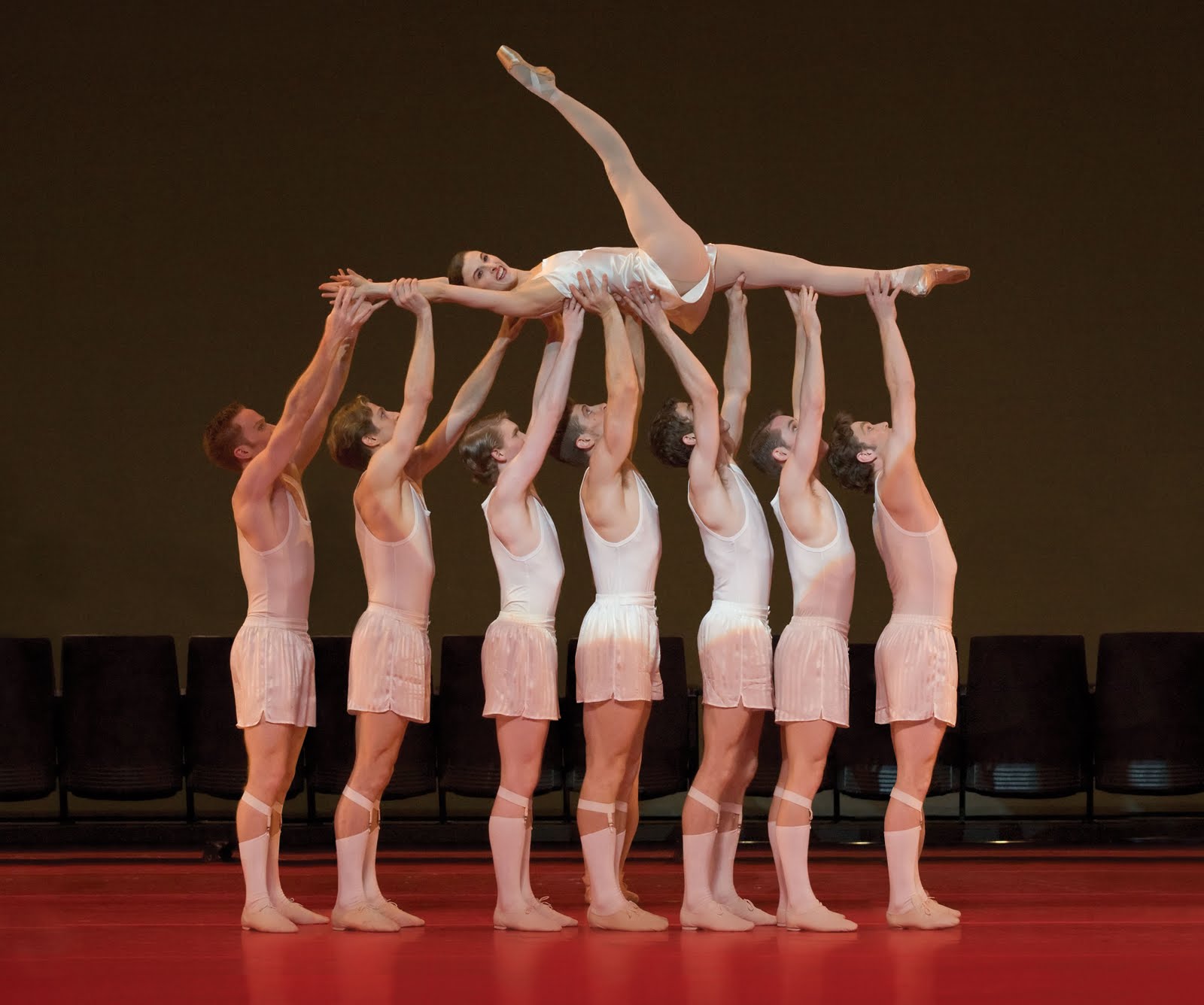

Anne Mueller and company in Christopher Stowell's Eyes On You. Photo by Blaine Truitt Covert.

Eyes On You is such an audience favorite.  Why do you think people respond to it so much?
I hate to use the word “accessible,” but I think the thing that scares people sometimes about dance is “I don’t get it,” and there’s no question of not getting it, really.  Well, actually – once, I forget if it was a review or if it was someone talking to me, but they said, “I don’t get why they’re in their underwear,” and I’m like, “Uh, it’s funny.  That’s it.  That’s the end of the story.”  “Well, if they were in the movies they wouldn’t be in their underwear!” And I’m like, “Um, you’re thinking way too hard.” (Laughs)  Like, it’s madcap.  Whatever.  What was the question?  Oh, accessibility.  Right.  So, comfort level – I think it makes people relaxed, like, “I get this genre.”  I think a lot of people like a little glamour too, and it has beautiful costumes that move a lot.  And all of that also makes the dancers relax, and I think audiences get to see maybe more personality than they might in other [ballets], which is more appropriate in this, too.  And it’s very infectious music, too.  You feel yourself snapping your fingers a little bit, like, “I know the words to this song.”  It’s just fun.

What’s your favorite Cole Porter song?  Do you have a personal favorite?
My favorite recording in the show is the first one, “De-Lovely,” because it’s really, really clever – the lyrics are really clever.  You know what’s really good – it’s not in the show – is, how does it go?  (singing unintelligibly under his breath) Oh, it’s “Let’s Do It, Let’s Fall In Love.” Brilliant lyrics, so funny.  I almost used a recording of Alanis Morissette singing that [from the film De-Lovely], but it kind of fluctuates tempo a lot – so you’re like dancing dancing dancing, “Wait, why is she slowing down?” [EDITOR’S NOTE: Rather than transcribe for you the next 5 minutes where we geeked out about the De-Lovely soundtrack, I’ll just give you the link and tell you that Christopher’s favorite track is “True Love” sung by Ashley Judd, and mine is “Night and Day” sung by Kevin Kline with John Barrowman of Doctor Who and Torchwood fame.  Now back to our regularly-scheduled programming.]

So how does the process change, now that you’re doing it again with different dancers?
Honestly, with a ballet like this, it is a little – not “challenging,” but there’s another dimension to it.  Because you want, if not the same, a similar, equally effective effect, and people are different people with different bodies and different personalities.  So I probably adjust things in this more than I would in something else, because the point is the ultimate effect and not the individual steps, necessarily, or where to put the emphasis of either a gag, or a romantic look, or whatever like that. But I do get attached in something like this more than in other things, like, “You’re not doing that thing that so-and-so did that was so funny!”  But then I have to step back and go, “They can’t be that person.” And I’ve found that asking them to do something that was basically an inspired moment by one dancer, asking another dancer to do it is usually not effective.  It wouldn’t feel natural to them.

So what made you decide to bring it back for this season, and how does it fit in with the other pieces in Song & Dance?
Well, we brought it back because, you know, marketing directors are always happy.  Like, “Give me something that’s gonna sell a lot of tickets!”  (Laughs)  In this particular program – so Square Dance wasn’t on the program yet when I planned it because we added it later.  [With Left Unsaid and Speak], well, I don’t know if “heavy” is the right word, but there’s some darkness and some earthbound-ness and some seriousness about those works that needed some complementing with something light.

How did you come up with the name Eyes On You?  It’s not in any of the songs in the piece.
The naming of the piece was actually fun.  I was choreographing it during OBT Exposed!, when we had the tent in the park in the fall, and I think we showed some Cole Porter movies in the evening and had some popcorn, to sort of get people who were interested in the ballet focused on Cole Porter and the process of creating this new work.  And then I think I had to give a lecture one night, and I hadn’t come up with a name for the piece, and I said, “Well, I’ll throw it out to the audience.”  There were maybe fifty people there, and everyone wrote down their thought for a name for the piece and we collected them, and – it was actually longer, it was “Eyes on blah blah blah blah blah something,” but I read all of them, all those little slips of paper and then saw that one.  And I reduced it, edited it a little bit, and liked it, and got in touch with that person, and they got credit and free tickets to the ballet.

That’s awesome.
Yeah.  I like the title.  People have said, you know, is it “Eyes On You” or I-apostrophe-S, like “I’s on you?”  (Laughs)

It works on so many levels.
Yeah.


-----------

Song & Dance, featuring Eyes On You is at the Newmark Theatre April 21 - May 1.

more posts about Song & Dance | Buy Tickets to Song & Dance

Tuesday, April 12, 2011

Six Degrees of Cole Porter

By Claire Willett

Cole Porter

“Six Degrees of Separation” is a statistical theory model which suggests that every human being on earth is connected to every other human being on earth through no more than six other people. That is beyond the scope of this undertaking, so we’re going to stick with its far-less-weighty spinoff, the pop-culture parlor game “Six Degrees of Kevin Bacon,” which adapts this model to suggest that any Hollywood actor can be connected to movie star Kevin Bacon through no more than six movies. Bacon, a true Renaissance man (actor, director, musician, writer, producer) is a prolific Hollywood workhorse with over 70 movies to his name, in many different genres, which means has amassed a staggering array of celebrity co-stars, which is why the game works.

Kevin Bacon in Footloose

You may be skeptical. “Sure, it would work with Rob Lowe or Demi Moore,” you say, “but what about someone like, say, Orson Welles?”

Orson Welles

Easy! Orson Welles was in the original Casino Royale with Ursula Andress who was in Clash of the Titans with Laurence Olivier who was in Dracula with Frank Langella who was in Frost/Nixon with Kevin Bacon. BACON SCORE = 4.

Kevin Bacon is all well and good, but if we want to talk about the ultimate Renaissance man we must go back to singer/songwriter/pianist/musical theatre composer/social butterfly Cole Porter, who seemed to know every even remotely famous person in the first half of the 20th century. The hottest silver screen stars sang and danced in his films and Broadway shows; celebrity composers and artists hung out at his lavish cocktail parties. He defined an entire era with his witty lyrics and champagne-sparkling melodies, and the reverberations of his impact on popular music and culture are still felt today. Was there anyone worth knowing in 1920’s Paris that Cole Porter never shared a drink with? Not by my reckoning. In honor of our upcoming Cole Porter-themed ballet “Eyes On You,” I’d like to test that theory with a little game called “Six Degrees of Cole Porter.” Stop scrolling as you make your guesses - the solution is right below the image.  (If you figure out a way to get there in fewer moves, post it in the comments.)

Ready? Let’s play!


6 MOVES: Black Swan star Natalie Portman 

Natalie Portman in Black Swan


**NATALIE PORTMAN SOLUTION**

Natalie Portman was in Closer with Julia Roberts who was in Ocean’s Eleven with Elliott Gould who was in The Muppet Movie with James Coburn who was in Charade with Cary Grant who was in The Philadelphia Story with Jimmy Stewart who was in Born To Dance with a score by Cole Porter.


5 MOVES: Film and Musical Theatre Actor Hugh Jackman 

Hugh Jackman


**HUGH JACKMAN SOLUTION**


Hugh Jackman did voice-over work for Happy Feet with Robin Williams who was in Dead Poet’s Society with Robert Sean Leonard who stars on House with Hugh Laurie who was in Jeeves and Wooster written by PG Wodehouse who wrote the book to Anything Goes with Cole Porter.


4 MOVES: First Lady Eleanor Roosevelt

First Lady Eleanor Roosevelt


**ELEANOR ROOSEVELT SOLUTION**
 
Eleanor Roosevelt was married to Franklin Delano Roosevelt who was succeeded in the Oval Office by Harry Truman whose Secretary of State was Dean Acheson who was roommates at Harvard Law School with Cole Porter.


3 MOVES: Fashion Designer Coco Chanel 

Coco Chanel


**COCO CHANEL SOLUTION**
 
Coco Chanel had an affair with Igor Stravinsky who composed Firebird for the Ballets Russe who were once hired to perform at an extravagant private ball in Venice by Cole Porter.


2 MOVES: Who’s the Boss star Tony Danza 

Tony Danza


**TONY DANZA SOLUTION**
 
Tony Danza was in the Laughing With the Presidents TV special with Bob Hope who was in Red, Hot and Blue written by Cole Porter.


1 MOVE: Fred Astaire 

Fred Astaire


**FRED ASTAIRE SOLUTION**

Fred Astaire starred in Gay Divorce written by Cole Porter.


Want to take a stab at it? Try connecting Cole Porter and OBT Artistic Director Christopher Stowell. Yes, it can be done, we’ve tested it! The first person who posts a comment below doing it in the fewest number of moves by April 15th (feel free to be creative!) will win a pair of tickets to Song & Dance. Post your ideas below in the comments!

Tuesday, March 29, 2011

The Life and Times of Anne Mueller Part Four: Anne on Christopher


OBT staffer Claire Willett sits down with Anne Mueller to talk all things Christopher Stowell – how she met him, how she would describe him in three words (HINT: she can’t), her favorite Stowell role, how she’s grown as a dancer over the past few years, and the one time she got to dance with him.


by Claire Willett

CW: What was the first role you danced for Christopher?
AM: Well, the first rep was Duo Fantasy, which was a ballet of his father’s; Rubies; a Helgi Tomasson pas de deux called Twilight, which sounds weird now because of the vampire books but I think that’s what it was called; and then [Paul Taylor’s] Company B. I danced the "Pennsylvania Polka" in Company B. I also danced in the corps of Rubies, and I was second cast in Duo Fantasy, which was a trio. And I really liked Duo Fantasy, it was very much a kind of movement that I was really comfortable doing and liked doing a lot. But the first kind of featured role he put me in was the "Pennsylvania Polka".

What’s your favorite thing you’ve worked on since Christopher got here?
I think my most favorite thing of my time with Christopher is the new works that he’s created. I absolutely love the process of the creation of new work, from all angles – I like it at the front of the studio, I like to be a dancer doing it, I just like everything about it. And his approach to how he wants us to work extends to his creation of new material, so I suddenly felt like I had this outlet and opportunity to bring more of myself to what I was doing. And it’s really exciting when you do that and somebody’s interested in it. It makes for – I hesitate to use the word “collaborative,” because it’s not a collaboration; when he makes work, it’s his work – but you as the paint on the canvas get to define a little more about where the paint goes. (Laughs) Not a perfect analogy. But you know what I’m saying.

What’s your favorite role that Christopher created on you?
Rite of Spring. Definitely. I feel like that choreography and dramatic tone and musical design, I think all of it captures who I am as a dancer and a person more perfectly than anything else I’ve ever done.

Anne Mueller and Lucas Threefoot in Christopher Stowell's The Rite of Spring, 2011. Photo by Blaine Truitt Covert.

Did it feel differently doing it again? Was it more relaxed having it under your belt the second time, because you’d been there before, or do you like the adrenaline of doing it the first time?
Both times were an amazing experience. I think a lot of times with me, when I come back to something, I want more. I want more the second time around, like, this position needs to be bigger, longer, deeper, I just wanted to give it more volume. But I did dance with a different person the second time around, and that inevitably changes the process too. Which is a fabulous experience. But it wasn’t like returning to what it had been before – it was sort of inherently different.

What have you seen in terms of how the company has grown and changed since Christopher got here?
Well, when he got here, the group that he started with was an amalgam; some people were holdovers from the James  years, and then there were all these other people he had pulled together from various different auditions and places – some of them he knew well and some he barely knew at all. It was a real potpourri of people initially. I think it really helps to have a director that’s a choreographing director, because I think through the creation of work and through having the dancers dance the work of the director, we build an understanding of – I don’t want to say “style,” but, what is important in the vision of this director. I think that he chooses people that are performers. Not in a Broadway, jazz-hands kind of way, but I think he likes people to be exciting and in the moment and really give themselves to the performing experience, and not, like, be careful at all. He doesn’t want us to be careful. So I think generally we’re a group of people that really like to just get out there and put on a show. …. Christopher, he wants you to explore yourself as an artist, you know, so there’s a lot more freedom to interpret and be musical, for instance. He himself, you can tell, is an incredibly, incredibly musical person and performer, and he really increased my level of awareness about that and certainly opened up that as an area of exploration for me. He also encourages a really sophisticated use of the upper body – of port de bras and the upper body “epaulement” we call it, “shouldering.” So that’s something that’s very important to him, and you can see it in the dancers in the company.

So I think that we’re courageous performers, we’re musical, and we try really hard to have sophisticated port de bras. (Laughs) And, you know what? Even more than that, I think personality-wise, like, we have a lot of very funny people, you know? These things are important when you’re going to be in the studio with somebody for long hours and under lots of stress with them. It’s important that the working environment be a place that feels . . . I don’t want to use the word “comfortable” because that’s not the right word, but feels good and is positive and creates an environment in which we can excel.


Christopher Stowell choreographing for the world premiere of The Rite of Spring in 2009. Photo by Blaine Truitt Covert.
That you like coming to work with those people.
And he likes working with those people. And we like working with him.

And I think that comes through in the dancing. Like, I didn’t come here with any ballet background and it was astonishing to me, when I first saw The Concert, that ballet could be funny. It just wasn’t –
It wasn’t in your consciousness.

Right. And then all of a sudden you’re like, “This is hilarious.” And those personalities come through, so the dance can be funny, or sexy or compelling –
Or scary.

Or scary, yeah.
Any of those things.

Emotions that people who don’t know a lot about ballet don’t think of as –
As being part of the spectrum.

Yeah, as being something that ballet evokes.
Right.

What is Christopher like backstage on opening night? Does he get fidgety, or is he pretty calm?
You know, he’s really good about knowing when it’s time to step away and let the experience be in the dancers’ hands. It’s really uncomfortable for the dancers, once you’re dealing with the stress of even dress rehearsals, let alone opening night; and if someone’s, like, breathing down your neck, that doesn’t help. So he’s great about knowing when to just let it be in our hands. I’m sure he has an amount of stress or anxiety or anticipation or nervousness, but he does not put that on us.

Anne Mueller and Christopher Stowell backstage before The Stravinsky Project. Photo by Motoya Nakamura for The Oregonian.

He can sort of walk away.
Yeah. Which is great. (Laughs) Because you have your own to deal with.

So in terms of transitioning into your new role at OBT, what are you most excited about in the new dynamic of how you’re going to work with Christopher? I mean, you’ve been doing it –
Yeah. That’s exactly what I was going to say. What I really like about this is it’s NOT a new role. It’s an expansion of a role I’m already filling, so I don’t feel like I’m leaping into some great vast unknown. I work in the studio with the dancers, I set ballets, there’s a dynamic that’s established. And there’s a dynamic as to how I work with him on matters outside the studio that’s already established too. So I look forward to just doing that a lot more. I feel like I already have a pretty good level of involvement with the administrative staff, but I look forward to more of that, getting to know people better and work with them more closely and know more about what everybody does. (Laughs) That’s kind of a lame answer.

Tell me a funny Christopher story.
I got to dance with him one time, which was really a lot of fun for me. He was the surprise guest artist at Susannah Mars’ Mars on Life show one year. She wanted Christopher to dance, and he asked me if I would dance with him, and of course I was very, very flattered and said yes. And to make it even more fantastic and surprising, we did a dance choreographed by Yuri. So it was like in the middle of Nutcracker, Christopher and I were in the studio together as dancers with Yuri Possokhov, choreographing, I think it was Irving Berlin’s “Let Yourself Go.” It was hysterical. I think I was just trying to behave, and be what I was supposed to be in the moment, and the two of them, they have so much camaraderie, so I was seeing a side of their relationship that I’d never seen before. So that was surprising and new. And actually performing was a total blast. It was great. I feel like it never would have happened that we would have ended up in the same place at the same time dancing together, but I could tell even before that that he’s someone I would have loved to have had the chance to dance with. So that was very cool to do that.

So then the next year we went back, and he says “I’m not dancing again, I’m retired. So what are we going to do this year?” So we engineered a sort of audience participation number, which was just a hysterical good time. We made up some super basic vocabulary that anyone could do. We just met in the studio on one off day and made up about eight basic moves, and then we put the eight basic moves together in three different phrases. One of them was “Elf Walk,” one we called “The Sugarplum Fairy” which was a very simplified version of something the Sugarplum Fairy does in her variation, and then I think we did (she does a huge “jazz hands” arc) “Snowflakes!” They were fun, a little bit goofy, and very easy. So we designed this dance for I think nine people. We got nine volunteers from the audience and we taught them their material and cued them to do their material on the music, so it was like (snapping her fingers) “Group A, 6, 7, 8! Group B, 6, 7, 8!” And then we sort of marched them into a new, mixed-up pattern, so it was like ABA in the first line, then CBC in the second line, and then cued them to do their material. So it looked super fancy. It was great because we were showing the audience “This is how you make choreography – you start with these themes and then manipulate them in these ways.” But it was just absolutely hysterical; the audience was having a blast and the people dancing were having a blast. It was a really good time. I had a wand, I wore a crown, it was great.

And you’ve done Susannah’s show with him every time, right?
Right. And then this year Steven and I danced and he came and talked. Those were fun.

So if somebody came to you who had never seen anything Christopher had choreographed before, and was like, “What’s his choreography like?”, how would you describe it?
Well, I would probably pick a couple different ballets and say “Go look at these,” so they could kind of experience the range of where his work goes. I would pick something classical like Sleeping Beauty, and then I would pick something like Rite of Spring, and then I would pick something like Eyes on You. I think what I would say is that because he’s such an incredibly musical person, the work that he creates – the style of it – is absolutely defined by what the music is. He does not choreograph Rite of Spring the same way he choreographs Eyes on You, you know?

I’d think you’d get to know somebody very quickly when they’re making work on you and you’re collaborating in that way. Yes? No?
Well, within the confines of the studio. I mean, the way we work in the studio, you’re not sitting down having tea with someone, talking about the finer points of life. It’s a very mission-oriented time. I’m kind of thinking back on when he made Eyes on You. Adin was the first thing he choreographed on me, actually, but I was with a partner, a much more experienced partner who had been choreographed on a lot, and I think in that experience I kind of just responded to the dynamic that was happening between the two of them, so I was like, “Oh, okay, I see how this is going here.” And then for Eyes on You, when he first started it, I think the very first rehearsal for that piece was the two of us in the studio with just each other. And that can be a really intense situation – one dancer, one choreographer, nobody else around. It’s very vulnerable for everyone. But I think we got over the initial thing of, “Okay, this is a little weird,” pretty quickly. Once I realized that it was funny – that there was a sense of humor to the piece – once I caught on to that, we had a blast.

Anne Mueller and Karl Vakili in Christopher Stowell's Adin, 2004. Photo by Blaine Truitt Covert.


I come at it from a background in theatre, so first rehearsals are often, like, everyone sits around and talks about their feelings.
Nobody talks about their feelings in ballet. It’s the opposite of that. Not that we stuff them away, but –

But it’s a whole different ballgame.
A whole different ballgame.

What are three adjectives that describe Christopher’s personality to you?
Curious. “Creative” is so generic . . . I don’t want to say that. Thoughtful, without being overly analytical. That’s not an adjective, but –

No, I’m with you.
Okay. And then – funny. Clever. Clever, but in a humorous kind of way. Not like Sherlock Holmes. (Laughs)

Can that be the title of this article? “CHRISTOPHER STOWELL: Clever, But Not Like Sherlock Holmes.”
(Laughs) Yeah.


Are you an Anne fan? What do you think is Anne’s most recognizable, iconic role? Post your thoughts below in the comments!

More Celebrating Anne Stories | All About Anne | Tickets to Song & Dance

Monday, March 21, 2011

Christopher's Oregonian Profile


In case you missed it, here is the link to Artistic Director Christopher Stowell's profile article in Sunday's Oregonian.

Here's an excerpt:

"Why all the Balanchine and Robbins works in OBT's repertoire?" Stowell says. "I think that these choreographers did so much to define and advance ballet in America that any company that aspires to a high level must perform their greatest works as central to the canon of this art form. Audiences deserve to see them, in the same way that classical music audiences deserve to hear Beethoven and Mozart."

Still, OBT is anything but a museum company. Stowell has created eight world premieres for the company, and he's commissioned new work from in-demand choreographers like Nicolo Fonte, Yuri Possokhov and Christopher Wheeldon, arguably the most sought-after dance maker in the world.

West says Stowell should be commended for taking risks with young and sometimes inexperienced choreographers, and that his background and relationships have helped him improve the programming at OBT.

"I think it needs to be said that Stowell has been able to program stuff Canfield couldn't because of the connections he developed during his long career as a dancer with San Francisco Opera Ballet and his pedigree," West says. "Kent and Francia were both in the New York City Ballet and directed Pacific Northwest Ballet for close to three decades. This gave (Stowell) contacts that enabled him to program three Robbins ballets, Paul Taylor's 'Company B,' three works by Christopher Wheeldon, who is a friend, even an Ashton ballet and a ton of Balanchine."

Read the whole article here.

Monday, February 21, 2011

"It's Exhilarating to be Someone's Creative Instrument" : The Creation of OBT's Firebird

From the very beginning of his time with OBT, Artistic Director Christopher Stowell intended that the company would develop a repertoire of works “to scores written specifically for ballet. For the initial effort in that direction,” he says, “I asked Yuri Possokhov to choreograph Stravinsky’s Firebird in 2004. He felt a bit confined at first. He had never thought of attempting it, and didn’t even like the music much at that point.”

“Yes,” Yuri elaborates, “I want to say I never liked the music before. Now I love it. When you listen to music and say immediately you don’t like it, it doesn’t mean anything. When you know it well, you have the right to say you love it or hate it.” As Yuri’s Firebird developed, he enjoyed having the foundation of the narrative for his choreography.

Says Christopher, “External restrictions can provide helpful parameters.”

During the 2003-04 season, Yuri was still a principal dancer with San Francisco Ballet. He had to choreograph Firebird in December of 2003, when he wasn’t performing. Rather than being able to choose his own schedule, he had to work with the dancers he could get on any given day, structured around OBT’s Nutcracker performances. Like many ballet situations, they had to work when they had small windows of opportunity. (As the great choreographer George Balanchine said, “…inspiration, it’s not anything that’s all of a sudden, like a stomach ache. There’s no such thing as inspiration. You have to work.”)

Yuri didn’t have the luxury of being able to show up unprepared; he created the entire Firebird in three weeks. He had gone over and over the music before coming to the studio.

Historian Lynn Garafola has observed that, “Between choreographer and dancers exists a special kind of intimacy. Each gives to the other; each reveals the other; each needs the other to complete himself as an artist.” That special intimacy developed as Firebird evolved.

Susan Gladstone, who was ballet master at the time, described “Yuri’s larger-than-life personality and infectious enthusiasm. He certainly cultivated an environment in which the dancers wanted to push beyond their limits. In turn, inspired by OBT’s dancers, Yuri came up with seemingly impossible steps that, after a few days’ work, became not only possible, but beautiful.”

Paul DeStrooper, who was Ivan in one of the 2004 casts, said “Yuri demands a lot—he’s a dancer and he knows what’s possible. He would say, ‘I want you to do something like this,’ then demonstrate loosely and let you work it out. He gave you time to get it in a comfort zone that’s in the aesthetic he wanted. He’s attuned to the musicality, so you can go with the melody and phrasing of the piece, not only the counts.”

Said Alison Roper, who danced the Firebird in one cast in 2004, “It’s exhilarating to be someone’s creative instrument. Some of Yuri’s movement is narrative of what’s happening in the story, without being mime. In the pas de deux between the Firebird and Ivan, there are ‘toss-lifts,’ like she’s trying to fly away. Yuri would give us something like that and say, ‘Just do, enjoy yourself. Oh, I love that.’”

More posts about The Stravinsky Project | Buy Tickets to The Stravinsky Project